
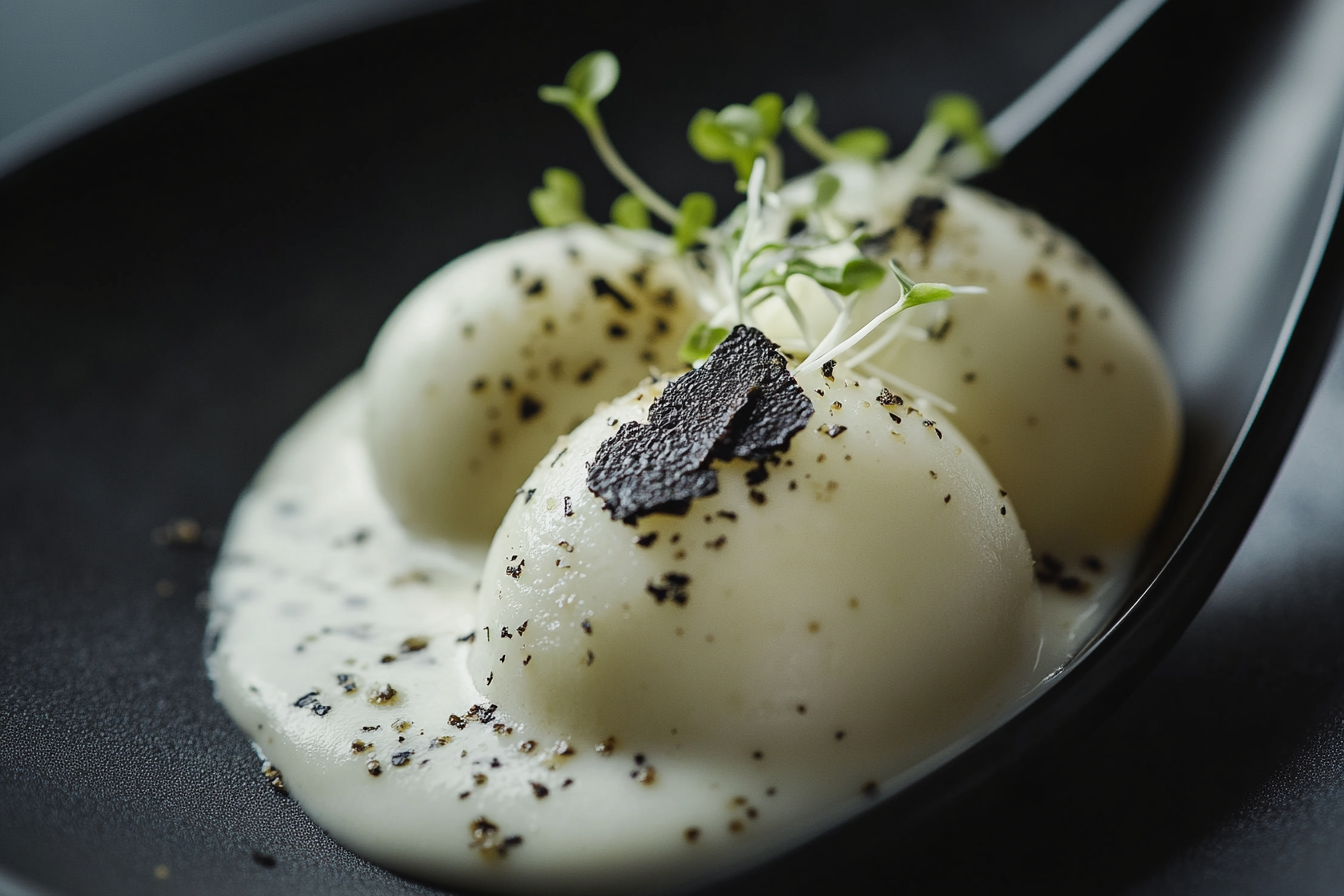
Truffle Spherification with Parmesan Foam turns one small bite into a sequence: a delicate membrane gives way, warm earthiness floods the palate, and airy Parmesan follows with salt and depth. The effect looks theatrical, but the real pleasure is in the contrast of textures and the discipline behind them.
This is a recipe where precision matters more than improvisation. I measure the functional ingredients rather than eyeballing them because a fraction of a gram can change the texture of the sphere, and I keep the bath time tight because I want the outside just strong enough to survive handling while the center stays fluid. The Parmesan foam gets the same attention. Its flavor should be rich and unmistakably savory, but the texture needs to feel almost weightless beside the truffle.
Good organization is part of the technique. Have the plates, tasting spoons, garnishes, rinse bath, and tools ready before the final batch goes into the alginate. Once the spheres are formed, they should move from bath to rinse to plate with as little handling as possible. That is how you preserve the small moment of surprise that makes this appetizer worth the work.
The Heart of Truffle Spherification with Parmesan Foam
The point of this dish is not molecular gastronomy for its own sake. The technique earns its place because it changes how the flavor arrives. A spoonful of truffle sauce gives you truffle immediately. A sphere delays it by a second, then releases it all at once. That pause is the entire architecture of the bite.
The Parmesan foam works because it does the opposite. Truffle is dark, concentrated, and earthy. Parmesan is equally intense in flavor, but aerating it stretches that intensity over a lighter texture. Instead of two heavy components competing, one bursts and the other dissolves.
I pay close attention to membrane thickness because that is the hinge between elegant and clumsy. If the outside is too thin, the sphere breaks before it reaches the guest. If it is too thick, you feel the gel before you taste the truffle. The correct membrane should be strong enough to lift and almost disappear when you bite.
That is also why plating is not an afterthought here. Everything should be ready before the last spheres are formed. This appetizer is at its best when the sphere is fresh, the foam is warm and airy, and the garnish is already waiting.
What Makes This Dish Work
The truffle liquid needs depth without heaviness. Unsalted mushroom broth gives the base a savory backbone, black truffle juice pushes the aroma in the right direction, and fresh truffle contributes the volatile, earthy character that makes the filling read as truffle rather than simply mushroom. A very small amount of truffle oil can sharpen the aroma, but it should stay in the background. Truffle oil is seasoning, not the foundation of the dish.
Calcium lactate gluconate is the functional ingredient inside the flavored liquid. In reverse spherification, the calcium sits in the filling while sodium alginate sits in the bath. Where the two meet, a gel membrane forms. That arrangement is useful here because the interior can remain fluid instead of slowly turning solid from the outside inward.
The tiny amount of xanthan gum is not there to make the filling thick. It gives the truffle base just enough body to enter the bath in a controlled spoonful instead of flattening immediately. At 0.1 percent, you should barely notice it on the palate.
The alginate bath deserves the same precision. Distilled water removes a major variable because tap water can contain enough calcium to interfere with the bath. The bath also needs time to rest after blending. Air bubbles look harmless in the bowl, but they can distort the surface of a sphere or create weak spots.
For the foam, Parmigiano-Reggiano brings salt, nuttiness, and a long savory finish. Milk keeps the base fluid enough for the siphon, while cream gives the foam enough fat and structure to hold. The critical move is straining. I strain thoroughly because even small Parmesan particles can interrupt a clean discharge, and a smooth foam is part of the contrast this dish depends on.
Quick Substitution Guide
- Use calcium lactate in place of calcium lactate gluconate at the same 1 percent ratio if that is what you have.
- Use Grana Padano when Parmigiano-Reggiano is unavailable; expect a slightly softer, less concentrated cheese flavor.
- If fresh black truffle is out of reach, increase the truffle juice slightly and use truffle oil with restraint rather than trying to replace fresh truffle with a large amount of oil.
- Use a deeply flavored homemade mushroom broth instead of store-bought stock when possible; commercial broths can bring more salt than this delicate appetizer needs.
How to Make the Truffle Spheres and Parmesan Foam
Build the Alginate Bath First
Start with the component that needs to rest. Weigh 1000 grams of distilled water, then blend in 6 grams of sodium alginate. Add the powder gradually into moving water rather than dumping it in one place; alginate loves to form stubborn lumps when the outside hydrates before the center.
The bath will look foamy after blending. Leave it alone for about an hour. You want the surface calm and the liquid nearly free of bubbles before you form spheres. This is one of those moments where waiting does more for you than extra mixing.
Make a Smooth Truffle Base
Blend the mushroom broth, truffle juice, fresh truffle, and the small amount of truffle oil, then strain it very finely. Weigh 260 grams of the strained liquid before adding the functional ingredients. That number is important because the calcium and xanthan percentages are based on the weight of the flavored base.
Blend in 2.6 grams calcium lactate gluconate and 0.26 gram xanthan gum. The finished liquid should still pour freely, but it should fall from a measuring spoon as one controlled portion rather than spreading like water. Let it rest until the visible bubbles disappear.
Extract the Parmesan Without Clogging the Siphon
Warm the milk and cream to about 160°F. You are not trying to boil the dairy; you are giving the cheese enough heat to release flavor into the liquid. Stir in the finely grated Parmigiano-Reggiano and white pepper, remove the pan from the heat, and let it sit for about five minutes.
Now strain it twice. First use a fine-mesh sieve. Then pass the liquid through cheesecloth or a super-fine filter. The second straining is not fussy garnish work; it protects the siphon’s valve and gives you the fine, even foam this plate needs.
Transfer the strained base to a hot-rated 0.5-liter siphon, charge it with one N2O cartridge, and shake according to the siphon manufacturer’s directions. Hold it warm at roughly 140°F. Keep it below the maximum temperature specified for your siphon.
Form a Thin, Delicate Membrane
Place the alginate bath beside a bowl of cool rinse water. Portion the truffle base with a small measuring spoon and lower each portion gently into the alginate bath. Do not drop it from height; a hard landing makes an irregular shape and can fold the forming membrane onto itself.
Work in small batches and give each sphere space. Set them for about two minutes, turning very gently once if one side is sitting against the bottom. This is the moment I watch most carefully. Leave them too long and the membrane gets thicker than I want. Pull them too early and they may not survive the transfer.
Lift each sphere with a spherification spoon and move it straight into the rinse bath for 20 to 30 seconds. Then transfer it to a lightly oiled spoon or a small dish. Handle it as little as possible from this point forward.
Plate in the Order the Bite Needs
Dispense the Parmesan foam first. A small cloud is enough; too much foam buries the sphere and shifts the dish from precise to heavy. Set the truffle sphere beside or slightly into the foam, then finish with a very thin shaving of truffle and a few chive pieces.
Serve immediately. The guest should be able to take the whole sphere in one bite, so keep the portion modest. The shell breaks, the truffle center releases, and the Parmesan foam follows. That sequence is the reason for every gram and every minute in the recipe.
How to Serve This Appetizer So the Contrast Lands
This is a first-bite appetizer, not a course that needs a crowded plate. Serve it on a chilled ceramic tasting spoon, a small shallow plate, or a dark stoneware plate that gives the pale foam and glossy sphere visual contrast. Keep the garnish restrained. A slice of truffle and a few chives say enough.
For drinks, dry Champagne, Franciacorta, or another traditional-method sparkling wine works because acidity and bubbles cut through the Parmesan and reset the palate after the truffle. A dry fino sherry is another strong choice; its saline, nutty character mirrors the cheese without making the dish feel richer. For a nonalcoholic pairing, a cold sparkling tea with roasted or mushroom-like notes can carry the same contrast.
Build the rest of the menu lighter around it. Raw scallop, a clean crudo, roasted asparagus, or a delicate mushroom tartlet can follow without repeating the same trick. For dessert, go bright rather than heavy: lemon posset, poached pear, or a restrained citrus sorbet gives the meal a clean finish. This appetizer suits dinner parties, tasting menus, New Year’s Eve, and any occasion where one carefully engineered bite can set the tone.
Variations
White Truffle and Cauliflower
Replace part of the mushroom broth with very smooth cauliflower stock and use white truffle juice or a restrained white truffle oil. The flavor becomes softer and sweeter, which works especially well with a younger Parmesan foam. Keep the truffle oil measured; white truffle aroma can turn perfumed very quickly.
Porcini-Truffle Sphere
Steep dried porcini in the mushroom broth, strain it extremely well, then build the truffle base from that liquid. This gives the center more mushroom depth and makes the truffle feel less singular. It is a good variation when fresh truffle is limited but you still want a complex earthy filling.
Pecorino Foam
Replace the Parmigiano-Reggiano with a mature Pecorino Romano, but reduce the quantity slightly because Pecorino is sharper and saltier. The foam becomes more assertive and works best with a milder truffle filling. Taste the infused dairy before it goes into the siphon; extra salt is rarely needed.
Black Garlic Accent
Add a tiny smear of smooth black garlic puree under the Parmesan foam rather than mixing it into the sphere. Its sweet, fermented depth supports truffle without clouding the liquid center. Keep the amount almost dot-sized so the appetizer still tastes first of truffle and Parmesan.
Storage, Reheating, and Make-Ahead Strategy
The alginate bath can be made several hours ahead and kept covered in the refrigerator once the air bubbles have settled. Bring it back toward cool room temperature before forming the spheres so the texture stays predictable. The truffle base can also be mixed and chilled a few hours ahead; stir gently rather than re-blending unless it has separated.
Reverse-spherified truffle spheres can be made ahead for a short window, but this is not where I push convenience. If you need to hold them, keep them in a small amount of the same seasoned truffle base rather than plain water, and plan to serve them within about six hours. Plain water can dilute the filling, and extended holding works against the clean membrane you are trying to protect.
The Parmesan base is more forgiving. You can prepare and strain it a day ahead, keep it refrigerated in the siphon, and warm it gently before service if your siphon is specifically rated for hot preparations. Never heat a pressurized siphon beyond the manufacturer’s stated limit, and never improvise with an appliance that is not designed for warm foams.
Do not reheat finished spheres. Heat is not their friend, and the dish does not need the truffle center to be hot. The ideal contrast is a cool or room-temperature liquid center against warm Parmesan foam. Finished spheres also do not freeze well; freezing is useful as a separate formation technique, but not as storage for completed, rinsed spheres.
Using Leftover Truffle Spherification with Parmesan Foam Components
Truffle Broth for Risotto
Any unused truffle base that has not gone through the alginate bath can be folded into mushroom risotto near the end of cooking. Add it after the rice is nearly tender so the truffle aroma stays forward. Treat it as a seasoning liquid rather than a full stock replacement.
Parmesan Foam Over Eggs
Extra Parmesan foam is excellent over soft scrambled eggs, poached eggs, or a simple omelet. The aerated texture gives you cheese flavor without the heaviness of grated cheese melted directly into the eggs. Add it at the table, not into the pan.
Warm Mushroom Toast
Sauté mushrooms until deeply browned, spoon them over crisp sourdough, then finish with leftover Parmesan foam and a few drops of the unspherified truffle base. It turns the same flavor structure into something relaxed without wasting the careful components.
Equipment
- 0.01-gram precision digital scale
- Immersion blender
- Tall blending container
- 2 wide shallow bowls
- Fine-mesh sieve
- Cheesecloth or super-fine filter
- Spherification spoon or slotted spoon
- Demi-tablespoon or 2-teaspoon measuring spoon
- 0.5-liter hot-rated culinary whipping siphon
- 1 N2O charger
- Instant-read thermometer
Ingredients
Truffle Sphere Base
- 225 g unsalted mushroom broth well strained and cooled
- 25 g black truffle juice from preserved black truffles
- 8 g fresh black truffle finely grated
- 2 g black truffle oil use lightly; it should support, not dominate
- 2.6 g calcium lactate gluconate 1% of the 260 g flavored base
- 0.26 g xanthan gum 0.1% of the flavored base
Sodium Alginate Bath
- 1000 g distilled water for the alginate bath
- 6 g sodium alginate 0.6% of the water weight
Rinse Bath
- 1000 g cool water filtered or distilled
Parmesan Foam
- 180 g whole milk
- 160 g heavy cream
- 80 g Parmigiano-Reggiano finely grated
- 1 pinch white pepper finely ground
For Plating
- 4 g fresh black truffle very thinly shaved, optional but recommended
- 1 tbsp finely snipped chives or delicate microgreens

Instructions
Prepare the Alginate Bath
- Weigh 1000 g distilled water into a tall container. While blending with an immersion blender, rain in 6 g sodium alginate and blend until completely dispersed. Transfer to a wide bowl and rest for about 60 minutes, or until the foam and trapped air bubbles have largely disappeared.
Make the Truffle Base
- Combine mushroom broth, black truffle juice, fresh truffle, and truffle oil. Blend until the truffle is finely dispersed, then strain through a very fine sieve. Weigh 260 g of the strained flavored base into a clean container.
- Add 2.6 g calcium lactate gluconate and 0.26 g xanthan gum to the 260 g truffle base. Blend briefly until smooth, then let the mixture stand until visible bubbles subside. Keep chilled until the alginate bath is ready.
Make the Parmesan Foam
- Warm the milk and cream to about 160°F (71°C); do not boil. Remove from the heat, add the Parmigiano-Reggiano and white pepper, and stir for 5 minutes to extract the cheese flavor.
- Strain first through a fine-mesh sieve and then through cheesecloth or a super-fine filter. The liquid must be completely free of cheese particles. Pour into a 0.5-liter hot-rated culinary siphon, charge with one N2O cartridge, shake according to the manufacturer's directions, and hold warm around 140°F (60°C), never exceeding the siphon's rated temperature.
Form the Truffle Spheres
- Set the alginate bath beside a second bowl filled with cool rinse water. Using a 2-teaspoon or demi-tablespoon measure, lower portions of the truffle base gently into the alginate bath. Work in small batches so the spheres do not touch.
- Let each sphere set for about 2 minutes, turning it very gently once if needed. Lift with a spherification spoon, transfer immediately to the rinse bath for 20 to 30 seconds, then move to a lightly oiled spoon or small dish. Handle as little as possible.
Plate and Serve
- Dispense a small cloud of warm Parmesan foam onto each chilled tasting spoon or plate. Nestle one truffle sphere beside or partly into the foam. Finish with a whisper of shaved black truffle and chives. Serve immediately so the sphere stays delicate and the foam remains airy.
Notes
Chefts's Notes
- Use a precision scale for the alginate, calcium, and xanthan. Small ratio changes matter here.
- Distilled water is the safest choice for the alginate bath because stray calcium in tap water can start gel formation before you want it.
- Let both the alginate bath and truffle mixture rest until bubbles disappear. Trapped air gives you misshapen spheres and weak spots.
- Keep the setting time close to 2 minutes. A longer bath builds a thicker membrane and dulls the liquid-center effect.
- Strain the Parmesan base twice before it enters the siphon. One stray cheese particle is enough to compromise a smooth discharge.
- Set up plates, garnishes, spoons, rinse water, and tools before forming the final batch. The finished spheres should be handled as little as possible.
Nutrition
Questions I Get About Truffle Spherification with Parmesan Foam
What is the difference between direct and reverse spherification?
Direct spherification puts sodium alginate in the flavored liquid and calcium in the bath. Reverse spherification does the opposite, which is useful for larger liquid-center spheres because the filling itself does not need to contain alginate and the center can remain fluid after rinsing.
Why are my spherification spheres breaking?
The usual causes are a membrane that has not set long enough, a filling that is too thin to enter the bath cleanly, trapped air, or rough handling during transfer. Start by checking the weights and timing before changing the formula. Precision is usually the shortest route back to a stable sphere.
Why do I need distilled water for spherification?
Tap and spring water can contain calcium, and calcium reacts with sodium alginate. Distilled water removes that variable from the alginate bath so the gel forms where you want it: at the surface of the flavored liquid, not randomly in the bowl.
How long do spherification spheres last?
Reverse-spherified spheres can be held for a limited period, but their best texture is still close to service. For this recipe, make them as late as practical and use a short hold in seasoned truffle liquid if needed rather than storing them overnight.
Can I make Parmesan foam without a siphon?
You can make a Parmesan air with an immersion blender and a foaming agent such as lecithin, but it will not have the same creamy, stable texture as a siphon foam. For this particular appetizer, the siphon version gives a better contrast against the liquid truffle center.
Can I make truffle spherification ahead of time?
Yes, but only to a point. Prepare the alginate bath, truffle base, and Parmesan base ahead, then form the spheres near service. That keeps the membrane delicate and lets you spend your attention on plating rather than recovery.
How do you keep Parmesan foam from clogging the siphon?
Strain the infused dairy more thoroughly than feels necessary. Use a fine-mesh sieve first and a finer filter second, and never send visible Parmesan particles into the siphon. Smooth liquid in gives you a much better chance of smooth foam out.
A Small Bite Worth Doing Precisely
Truffle Spherification with Parmesan Foam succeeds because every element has a specific job. The membrane protects the surprise without becoming part of the chew. The truffle center arrives in one concentrated release. The Parmesan foam follows with warmth, salt, and air instead of weight.
This is not a recipe to rush, but it is completely manageable when the workstation is organized and the measurements are exact. Weigh the hydrocolloids, let the bubbles settle, strain the cheese base twice, and watch the bath time closely. Have the plate ready before the final sphere goes in. Then serve it in one bite and let the contrast do the talking. If you make it, come back and tell me how thin you pushed that membrane and what you paired with it; those small details are where this kind of cooking gets interesting.